Lasik
What is LASIK?
LASIK (Laser-Assisted In Situ Keratomileusis) is a refractive surgery procedure that uses an excimer laser to reshape the cornea, correcting the way light focuses on the retina. It is used to treat myopia (short-sightedness), hyperopia (long-sightedness), and astigmatism, reducing or eliminating dependence on glasses or contact lenses.
Am I a suitable candidate for LASIK?
A thorough pre-operative evaluation is essential to determine suitability. General criteria include:
- Age 18 years or older (ideally 21+), with a stable prescription for at least one year
- Corneal thickness adequate to allow safe laser treatment
- No significant dry eye disease
- No active eye infections, keratoconus, or uncontrolled systemic conditions such as autoimmune disease
- Not pregnant or breastfeeding
Suitability is determined only after a comprehensive screening examination.
What conditions can LASIK correct?
LASIK can correct myopia (up to approximately –10 to –12 D), hyperopia (up to approximately +4 to +6 D), and astigmatism (up to approximately 6 D), depending on corneal thickness and other individual factors.
What happens during LASIK surgery?
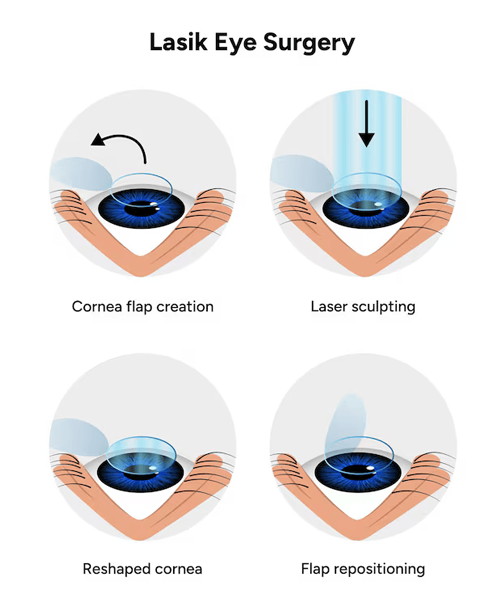
A thin flap is created on the surface of the cornea using either a microkeratome blade or a femtosecond laser. The flap is gently lifted and an excimer laser reshapes the underlying corneal tissue to the required prescription. The flap is then repositioned and adheres naturally — no stitches are required. The procedure typically takes 10–15 minutes per eye.
Is LASIK painful?
The procedure itself is painless as anaesthetic eye drops are used. Some patients experience mild discomfort, a sensation of pressure, or light sensitivity for a few hours post-operatively. Most patients are comfortable by the following day.
How quickly will my vision improve after LASIK?
? Most patients notice a significant improvement in vision within 24 hours. Vision continues to stabilise over the following two to four weeks. It is normal to experience some fluctuation, haloes, or glare in the initial period.
What are the risks and side effects of LASIK?
? LASIK is a very safe and well-established procedure, but as with any surgery, risks exist. These include:
- Dry eye symptoms (most common, usually temporary)
- Haloes, glare, or starbursts around lights, particularly at night
- Under- or over-correction requiring enhancement surgery
- Flap-related complications (rare with modern techniques)
- Regression of correction over time (uncommon)
- Rarely, infection or corneal ectasia
Your surgeon will discuss all risks in detail during your pre-operative consultation.
What are the restrictions after LASIK surgery?
? Typical post-operative guidelines include:
- Avoid rubbing the eyes for at least four weeks
- No swimming or water sports for four weeks
- Avoid dusty or smoky environments for two weeks
- Use prescribed eye drops as directed
- Wear protective eyewear if returning to contact sports
- Avoid eye make-up for one to two weeks
- Attend all scheduled follow-up appointments
Is LASIK permanent?
The corneal reshaping achieved by LASIK is permanent. However, natural age-related changes such as presbyopia (reading vision loss after age 40) and, less commonly, myopic regression can occur over time. The majority of patients enjoy stable long-term results.
Can LASIK be repeated if my vision changes?
In some cases, an enhancement procedure can be performed if there is clinically significant regression. This depends on the residual corneal thickness and other factors assessed at the time. Your surgeon will advise you during follow-up.
What is the difference between blade LASIK and bladeless (all-laser) LASIK?
In conventional LASIK, the corneal flap is created with a microkeratome — a precision mechanical blade. In bladeless or all-laser LASIK, a femtosecond laser creates the flap, offering greater precision in flap thickness and dimensions. Both are safe and effective; your surgeon will recommend the most appropriate technique for you.
Who is not suitable for LASIK?
LASIK may not be appropriate for patients with keratoconus or other corneal abnormalities, insufficient corneal thickness, severe dry eye disease, very high prescriptions beyond the treatable range, unstable refractive error, or certain systemic conditions. In such cases, alternative procedures such as SMILE Pro or phakic IOL implantation may be considered.